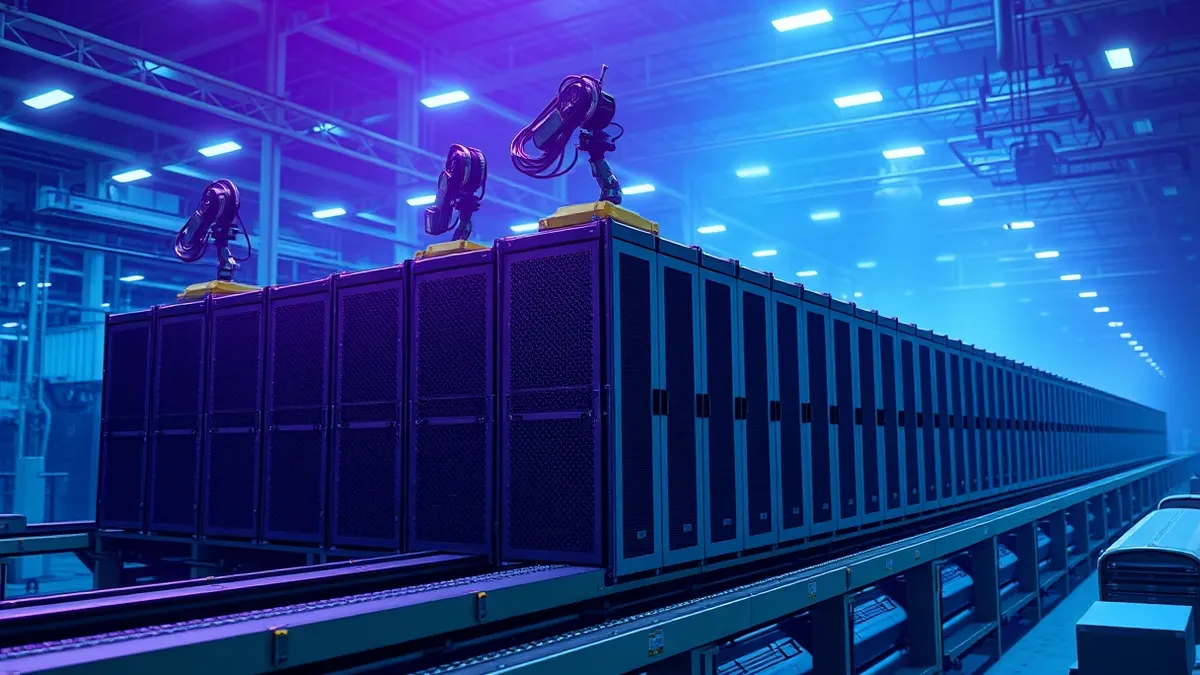
Runware, an AI infrastructure provider, stated to TechCrunch that it plans to construct a factory assembling prefabricated data center pods on a production line similar to automotive manufacturing. This development follows the recent unveiling of its Sonic Inference Pod, a modular unit built in a facility and shipped ready for installation. The company’s strategy focuses on scaling this modular approach to meet growing infrastructure demands through standardized, factory-built units rather than traditional on-site construction methods.
How we got here
The concept of prefabricated data center modules is not new, with competitors like Crusoe and Schneider Electric already selling similar pods. However, Runware distinguishes its offering by claiming faster shipping times and a dedicated manufacturing scale. The company has operated one factory for several years to build these pods and began constructing a second facility earlier this year. This second factory is expected to be completed within months and to begin operations early next year, forming the basis for their expanded production capabilities.
What is new
The primary change is the shift to an assembly line model for manufacturing these modular data centers. Runware co-founder and CEO Flaviu Radulescu told TechCrunch that the company aims to gradually increase production starting next year. The goal is to reach a capacity of 30 megawatts per day by 2028, which equates to nearly one gigawatt per month. This volume would match the entire expected annual data center power addition in the United States this year, highlighting the significant scale of their operational ambitions.
What to make of it
Runware differentiates itself from peers like Nvidia, which announced the Vera Rubin AI factories and DSX POD earlier this year to help others build infrastructure. Radulescu emphasized that Runware has already built a factory rather than just designing infrastructure for others. The company plans to bring pods online within 48 hours of arrival, covering installation and setup. Build times are expected to drop from three weeks to one day as production ramps up, with spare parts provided for component failures.
What the rules require
For model evaluators, compliance with this deployment model requires understanding the specific operational constraints and configuration options defined by Runware. The stated rules indicate that customers must either provide their own site for assembly or allow Runware to locate one. Power and internet connections are charged separately from the pod fees, meaning infrastructure budgeting must account for these external utilities. Evaluators must also consider that pods have a standard design but can be configured for specific customer requirements and the latest GPU chips.
Why it matters
- Rapid deployment timelines of 48 hours for online activation allow evaluators to test new models in diverse hardware environments much faster than traditional data center build cycles permit.
- The option to supply own GPUs means evaluators can maintain hardware consistency across tests while leveraging Runware’s modular infrastructure for scalability and geographic distribution.
- Daily production capacity targets suggest a future where standardized, factory-built compute environments become common, requiring evaluation frameworks to account for uniform hardware baselines rather than custom-built variations.
- Separate billing for power and internet implies that total cost of ownership calculations for evaluation workloads must explicitly include utility costs, which may vary significantly by the customer-provided site location.
Topics: AI infrastructure, Runware, data centers, modular compute, hardware deployment
Updated
Did this article give you the evidence you needed?
Your choice stays on this device. No public tally.Questions readers ask
How does Runware plan to manufacture its data center pods?
Runware intends to build a factory that assembles the modular data centers on an assembly line, similar to how cars are mass-produced, to increase speed and scale.
What is the target production capacity for Runware's factory by 2028?
The company aims to scale production to 30 megawatts of data center capacity per day, which is nearly one gigawatt per month, by 2028.
Can customers customize the hardware inside the Runware pods?
Yes, customers can supply their own GPUs or rent compute from Runware, and the pods can be configured to meet specific requirements and support the latest GPU chips.
Connected stories
Reading receipt
- Runware intends to scale its Romanian factory to produce 30 megawatts of capacity daily by 2028.
- The company aims to reduce pod build times from three weeks to one day using assembly line methods.
- Customers can rent compute or supply their own GPUs, with online activation targeted within 48 hours.